
Kαλώς ήρθατε στην online έκδοση της Επιθεώρησης Δερματολογίας – Αφροδισιολογίας
Με μεγάλη χαρά σας ενημερώνουμε για την έναρξη λειτουργίας της online έκδοσης του επιστημονικού περιοδικού Επιθεώρηση Δερματολογίας – Αφροδισολογίας. Η ηλεκτρονική μας πλατφόρμα (www.hdvr.gr) έρχεται να συμπληρώσει την έντυπη έκδοση, προσφέροντας στους αναγνώστες και τους συγγραφείς μια σύγχρονη, ευέλικτη και προσβάσιμη εμπειρία.
Τι προσφέρει η online έκδοση της Επιθεώρησης:
• Άμεση πρόσβαση στα άρθρα από οπουδήποτε.
• Εύκολη αναζήτηση και πλοήγηση σε τρέχοντα και παλαιότερα τεύχη.
• Δυνατότητα ηλεκτρονικής υποβολής άρθρων, με παρακολούθηση της διαδικασίας αξιολόγησης σε πραγματικό χρόνο.
• Εύχρηστο περιβάλλον για την online αξιολόγηση των άρθρων από τους κριτές.
Επιπλέον, με στόχο τη διεύρυνση της απήχησής μας στην επιστημονική κοινότητα, εργαζόμαστε στα εξής σημαντικά επόμενα βήματα:
1. Έκδοση του περιοδικού στην αγγλική γλώσσα, με σκοπό την πλήρη αγγλόφωνη κάλυψη και διεθνή πρόσβαση στις δημοσιεύσεις μας.
2. Συμπερίληψη του περιοδικού στο Index Medicus και άλλες μεγάλες επιστημονικές βάσεις δεδομένων, ώστε να αποκτήσει impact factor και να αναγνωριστεί παγκοσμίως ως έγκριτη πηγή επιστημονικής γνώσης.
Η εξέλιξη αυτή δεν είναι μόνο ένα ορόσημο για την Επιθεώρηση, το ιστορικό και κατ’ εξοχήν επιστημονικό περιοδικό της Ελληνικής Δερματολογίας – Αφροδισιολογίας αλλά και μια ευκαιρία για όλους τους συναδέλφους, ειδικευμένους και ειδικευόμενους, να προβάλουν το έργο τους σε ένα ευρύτερο, ελληνικό και διεθνές ακροατήριο.

Σας καλούμε να επισκεφθείτε την πλατφόρμα μας στο www.hdvr.gr και να συμμετάσχετε ενεργά σε αυτή τη νέα εποχή της Επιθεώρησης.
Με εκτίμηση,
Καθηγητής Αλέξανδρος Στρατηγός,
Εκδότης
The Hellenic Dermato-Venereological Review (HDVR), issued in print since 1937, is a property of Andreas Syggros Hospital, in Athens, Greece, funded by the “Andreas and Ifigenia Syggros” Trust. HDVR is a quarterly published Greek Dermatology journal well recognized in our discipline.
HDVR encompasses the current international trends in Dermatology-Venereology, informs on pertinent cutaneous and venereal diseases in scholarly reviews and original research articles, case reports and guidance for the clinical practice, and is a forum for the viewpoints of esteemed colleagues in Greece an internationally. Alongside the journal’s Editorial Board, consisting of experts and researchers with international contributions, we will be striving to meet high publishing standards.
HDVR aims to be a useful resource and provide continuing medical education, easily and freely assessed online for residents and specialist dermatologists in Greece and abroad.
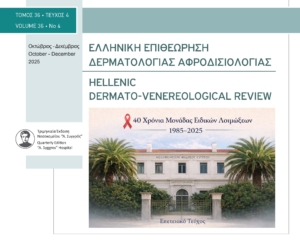
Latest Issue
Volume 36, Issue 4
Editor’s Choice
Special Infections Unit of “A. Syggros” Hospital: 40 years since its founding
Vasileios Paparizos, Varvara Vasalou, Sofia Kourkounti, Evangelos Daskalakis, Chrysoula Botsi, Konstantinos Verros, Electra Nicolaidou, Georgia Vrioni, Alexander Stratigos
Abstract: Special Infections Units (SIUs) were established and began operating soon after the first AIDS cases in Greece, with the purpose of caring for HIV patients. The name “Special Infections” was a result of the efforts of avoiding stigmatizing patients. One of the first Units was the one of “A. Syggros” Hospital, thus continuing the contribution of treating Sexually Transmitted Infections (STIs). In “A. Syggros” SIU have so far been included approximately 3300 patients, with 1600 of them being actively currently treated.
Latest Articles
The story of HIV/AIDS: Four decades of science, fight and hope
Varvara Vasalou, Theodoros Retsas, Αnna Strikou, Athanasios Drosos, Vasileios Paparizos, Electra Nicolaidou, Alexander Stratigos
Hellenic Dermato-Venereological Review 2025, 36(4): 175-178
ABSTRACT: From the first mysterious cases reported in 1981 to the innovative treatments of the 21st century, the history of HIV/AIDS stands as one of modern medicine’s most remarkable journeys. Over four decades, HIV has transformed from a fatal infection into a chronic, manageable condition thanks to antiretroviral therapy, with the advent of HAART in 1996 marking a turning point. Prevention strategies such as PrEP and the U=U principle have revolutionized both science and social perception, dramatically reducing transmission and stigma. Long- acting therapies and new drug classes further enhance adherence and quality of life. Despite major advances, global disparities in access to care remain a significant challenge. The story of HIV/AIDS is not only one of medical progress but also a testament to human resilience, solidarity, and the ongoing pursuit of an end to the epidemic.
HIV at the times of new therapies: Life expectancy, quality of life and new challenges
Varvara Basalou, Theodoros Retsas, Evangelos Daskalakis, Vasileios Paparizos, Electra Nicolaidou, Alexander Stratigos
Hellenic Dermato-Venereological Review 2025, 36(4): 195-198
ABSTRACT: Antiretroviral therapy has transformed HIV infection from a fatal disease into a chronic, manageable condition. Life expectancy among people living with HIV has increased dramatically, approaching that of the general population. At the same time, quality of life has improved thanks to simplified, highly effective, and less toxic regimens. However, new challenges have emerged, including comorbidities (cardiovascular, renal, metabolic, malignant, and psychiatric disorders), polypharmacy, and psychosocial stress. HIV in the 21st century is no longer defined by AIDS but by chronic management and aging. Comprehensive care now requires multidisciplinary collaboration, prevention of chronic diseases, treatment adherence, and the ongoing fight against stigma.
Missed opportunities in the diagnosis of HIV in Greece: Comparison with international evidence and clinical guidelines
Varvara Vasalou, Αnna Strikou, Chrysoula Botsi, Athanasios Drosos, Sofia Kourkounti, Electra Nicolaidou, Vasileios Paparizos, Alexander Stratigos
Hellenic Dermato-Venereological Review 2025, 36(4): 185-188
ABSTRACT: Mycosis Fungoides (MF) is the most common type of cutaneous T-cell lymphoma. However, it is rare in pediatric population. Most of the cases of pediatric MF present with hypopigmented patches and/or various other forms, which may often mimic common childhood dermatoses, thereby causing a delay in the diagnosis. Another entity that is often included in the differential diagnosis of MF in children is Annular Lichenoid Dermatitis of Youth (ALDY). About 20 years after its first description, ALDY is recognized as a distinctive lichenoid dermatosis with specific clinical and histological features, such as massive necrosis / apoptosis of keratinocytes, which is a pathognomonic feature. In this article, we present an interesting case from the Pediatric Dermatology Department of the “Andreas Sygros” Hospital, in which, based on the clinical picture, the diagnosis of both MF and ALDY could be possible. However, the histological findings make the diagnosis of Mycosis Fungoides more likely.
Trichophyton Mentagrophytes genotype VII: An emerging sexually transmitted fungus
Roxani Kapranou, Alexander Stratigos, Electra Nicolaidou
Hellenic Dermato-Venereological Review 2025, 36(4): 211-215
ABSTRACT: In recent years, there has been growing interest in dermatophyte infections, since emerging data suggest that transmission during sexual contact may also occur. The recently identified Trichophyton Mentagrophytes genotype VII (TMVII) has been associated with multiple cases of sexually transmitted dermatophytosis across several European countries. The aim of this review is to collect and analyze the available data regarding patients with TMVII infection, focusing on demographic characteristics, clinical presentation and therapeutic management. Furthermore, this review seeks to contribute to a better understanding of the infection, leading to early diagnosis and effective treatment in the future.

Guidelines for authors

View our latest issue

Follow us!