
Kαλώς ήρθατε στην online έκδοση της Επιθεώρησης Δερματολογίας – Αφροδισιολογίας
Με μεγάλη χαρά σας ενημερώνουμε για την έναρξη λειτουργίας της online έκδοσης του επιστημονικού περιοδικού Επιθεώρηση Δερματολογίας – Αφροδισολογίας. Η ηλεκτρονική μας πλατφόρμα (www.hdvr.gr) έρχεται να συμπληρώσει την έντυπη έκδοση, προσφέροντας στους αναγνώστες και τους συγγραφείς μια σύγχρονη, ευέλικτη και προσβάσιμη εμπειρία.
Τι προσφέρει η online έκδοση της Επιθεώρησης:
• Άμεση πρόσβαση στα άρθρα από οπουδήποτε.
• Εύκολη αναζήτηση και πλοήγηση σε τρέχοντα και παλαιότερα τεύχη.
• Δυνατότητα ηλεκτρονικής υποβολής άρθρων, με παρακολούθηση της διαδικασίας αξιολόγησης σε πραγματικό χρόνο.
• Εύχρηστο περιβάλλον για την online αξιολόγηση των άρθρων από τους κριτές.
Επιπλέον, με στόχο τη διεύρυνση της απήχησής μας στην επιστημονική κοινότητα, εργαζόμαστε στα εξής σημαντικά επόμενα βήματα:
1. Έκδοση του περιοδικού στην αγγλική γλώσσα, με σκοπό την πλήρη αγγλόφωνη κάλυψη και διεθνή πρόσβαση στις δημοσιεύσεις μας.
2. Συμπερίληψη του περιοδικού στο Index Medicus και άλλες μεγάλες επιστημονικές βάσεις δεδομένων, ώστε να αποκτήσει impact factor και να αναγνωριστεί παγκοσμίως ως έγκριτη πηγή επιστημονικής γνώσης.
Η εξέλιξη αυτή δεν είναι μόνο ένα ορόσημο για την Επιθεώρηση, το ιστορικό και κατ’ εξοχήν επιστημονικό περιοδικό της Ελληνικής Δερματολογίας – Αφροδισιολογίας αλλά και μια ευκαιρία για όλους τους συναδέλφους, ειδικευμένους και ειδικευόμενους, να προβάλουν το έργο τους σε ένα ευρύτερο, ελληνικό και διεθνές ακροατήριο.

Σας καλούμε να επισκεφθείτε την πλατφόρμα μας στο www.hdvr.gr και να συμμετάσχετε ενεργά σε αυτή τη νέα εποχή της Επιθεώρησης.
Με εκτίμηση,
Καθηγητής Αλέξανδρος Στρατηγός,
Εκδότης
The Hellenic Dermato-Venereological Review (HDVR), issued in print since 1937, is a property of Andreas Syggros Hospital, in Athens, Greece, funded by the “Andreas and Ifigenia Syggros” Trust. HDVR is a quarterly published Greek Dermatology journal well recognized in our discipline.
HDVR encompasses the current international trends in Dermatology-Venereology, informs on pertinent cutaneous and venereal diseases in scholarly reviews and original research articles, case reports and guidance for the clinical practice, and is a forum for the viewpoints of esteemed colleagues in Greece an internationally. Alongside the journal’s Editorial Board, consisting of experts and researchers with international contributions, we will be striving to meet high publishing standards.
HDVR aims to be a useful resource and provide continuing medical education, easily and freely assessed online for residents and specialist dermatologists in Greece and abroad.
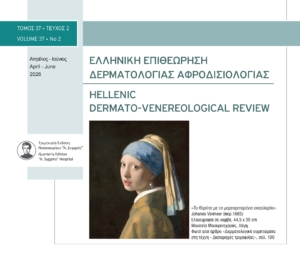
Latest Issue
Volume 37,
Issue 2
Editor’s Choice
Cutaneous squamous cell carcinoma: Updates in the European guidelines version 2026
Clio Dessinioti
Το διηθητικό ακανθοκυτταρικό καρκίνωμα του δέρματος (ΑΚΚ) αποτελεί μία από τις συχνότερες κακοήθειες και τη δεύτερη συχνότερη μορφή καρκίνου του δέρματος μετά το βασικοκυτταρικό καρκίνωμα. Η γήρανση του πληθυσμού, η αυξημένη έκθεση στην υπεριώδη ακτινοβολία και η ύπαρξη ανοσοκατεσταλμένων πληθυσμών αποτελούν βασικούς παράγοντες που συνεισφέρουν στην αυξανόμενη επίπτωση του ΑΚΚ.
Latest Articles
Hidradenitis suppurativa: Redefining the therapeutic strategy
Aikaterini I. Liakou
Hellenic Dermato-Venereological Review 2026, 37(2): 87-90
ABSTRACT: Hidradenitis suppurativa is a model of autoinflammatory disease, in which developments are rapid. The modern approach to the disease requires a shift in its clinical assessment from the traditional Hurley staging to the modern IHS4 clinical score. It also requires a reevaluation of antibiotics as first-line treatment and the development of clear criteria for initiating treatment with biological agents or small molecules. The main axes are the identification of risk factors for faster disease progression, as well as those groups of patients who will benefit most from the early initiation of effective treatment. This opinion article recalls the concept of the “window of opportunity” in hidradenitis suppurativa, and discusses the need to identify high-risk patients, while also listing some criteria for the early initiation of treatment with biological agents or small molecules.
The Role of Color Doppler Ultrasound in the Evaluation of Peripheral Arterial Disease
Marilena Domazou, Argyrios Fotinos, Vasileios Stavrianos, Ioannis Zampelis, Evangelia Christaki, Martha Chatzidimitriou, Ioannis Visvardis, Angeliki Papadopoulou
Hellenic Dermato-Venereological Review 2026, 37(2): 105-109
ABSTRACT: Chronic Limb-Threatening Ischemia (CLTI) represents the advanced stage of Peripheral Arterial Disease (PAD) and is experiencing a steadily increasing prevalence worldwide, imposing a substantial economic burden on healthcare systems. CLTI is associated with high morbidity and mortality rates, frequent limb amputations, and significantly reduced quality of life. Effective management of CLTI requires the involvement of a multidisciplinary team of healthcare professionals. However, limited awareness of the condition often results in delayed diagnosis and, consequently, postponed therapeutic intervention. Radiological evaluation of the lower limb arterial network is essential in patients with suspected CLTI, as it enables accurate disease detection, assessment of its extent and severity, and guidance of optimal treatment strategies aimed at limb revascularization.
Optimal Itch Response in patients with moderate and severe Atopic Dermatitis on dupilumab: real-world data
Georgios Sarris, Aristeidis Vaiopoulos, Aikaterini Tsiogka, Ileana Afroditi Kleidona, Theodora Douvali, Michail Bakakis, Stamatios Gregoriou
Hellenic Dermato-Venereological Review 2026, 37(2): 111-118
ABSTRACT: Background – Objectives: Chronic pruritus in Atopic Dermatitis (AD) constitutes an important morbidity factor. IL-31, an interleukin regulated by IL-4/13 activation, is the best-studied mediator of pruritus in AD. This study aspires to evaluate the pruritus-centered benefit of dupilumab, a monoclonal antibody acting as an IL-4/13 signalling inhibitor. Materials & Methods: A total of 75 patients with an 18.5-year mean duration of AD who were treated with dupilumab for at least 16 weeks were included. Rates of Optimal Itch Response (OIR), a clinical parameter defined by the combined criteria of EASI≤7, DLQI≤5 and PP-NRS≤4, were measured and the drug safety profile was assessed. Results: Clinical response in terms of EASI demonstrated a constant improvement (week 4: EASI≥50 in 65.33% of patients, weeks 16, 24 and 52: EASI≥50 above 90%). OIR reached 38.67% on week 4, almost doubled on week 16 (70.67%) and continued to rise on weeks 24 and 52 (79.66% and 86.67% respectively). Conclusions: Dupilumab exhibits an extremely high efficacy in tackling chronic AD pruritus, with an excellent and sustained clinical outcome and safety profile. The interconnection between therapeutic agent and patient-related response in a real-practice setting along with the individualisation of patient management may lead to minimizing disease burden and psychosocial impact of Atopic Dermatitis.
Deep cutaneous fusariosis in an immunocompetent patient: diagnostic and therapeutic challenges
Christina Spyridonidou, Sylvana Karamparpa, Electra Nicolaidou, Georgia Vrioni, Evangelos Daskalakis, Vasiliki Nikolaou, Eleni Remountaki, Efthimia Soura, Alexandros I. Stratigos
Hellenic Dermato-Venereological Review 2026, 37(2): 133-136
ABSTRACT: Deep cutaneous fusariosis caused by Fusarium spp. is a rare clinical entity, occurring more frequently in immunocompromised patients. We present the case of a 33-year-old immunocompetent male with deep cutaneous infection caused by Fusarium solani, who was hospitalized in our institution. The patient was initially treated with intravenous liposomal amphotericin B followed by isavuconazole, resulting in complete resolution of the lesions. The aim of this article is to raise clinicians’ awareness regarding the diagnostic approach and management of deep cutaneous fusariosis in both immunocompetent and immunocompromised patients.

Guidelines for authors

View our latest issue

Follow us!